Most length regret is not about how nails look in the salon. It is about the third day, at a keyboard, when every keystroke lands wrong. Choosing a length you can live with means working backward from your actual week: what your hands do for work, what you play, what you type on, and how much adjustment time you honestly have. At E Nails & Spa in Salisbury, the honest length conversation takes two minutes and saves two weeks of quietly hating your own hands.
Length is measured from the cuticle to the tip, but what you feel is the part past your fingertip. That free edge is the lever. A little of it changes how you pick up a coin; a lot of it changes how you do almost everything until your hands relearn the map.
A practical way to choose, step by step
- Start from your job, not the photo. List what your hands do all day. Typing, cash handling, patient care, food work, and warehouse work all punish length in different ways.
- Do the fingertip test. If you press a fingertip flat on a table, the part of the nail that lifts or bends first is the length you will feel. Keep the free edge shorter than the point where everyday pressure starts to lever it.
- Type something real. Before a long set, mimic your keyboard or phone use. If you normally type with fingertip pads, long nails force you onto the nail itself, which is slower and louder until you adapt.
- Account for instruments and hobbies. Guitar, piano, violin, climbing, gardening, and contact sports each have a working maximum. Bring it up in the chair; technicians hear these constraints every week.
- Respect workplace rules. Many healthcare, childcare, and food-handling roles require short nails for hygiene and safety, and some limit polish or enhancements entirely. Check the rule before you pay for length you have to remove.
- Go one step up, not three. If your natural nails sit at your fingertip, try a short extension or overlay length first. You can add length at the next fill; you cannot un-live two clumsy weeks.
- Plan the adjustment week. The first five to seven days with noticeably longer nails feel awkward. Buttons, contacts, zippers, and cans are the usual trouble spots. By the second week most people stop thinking about it.
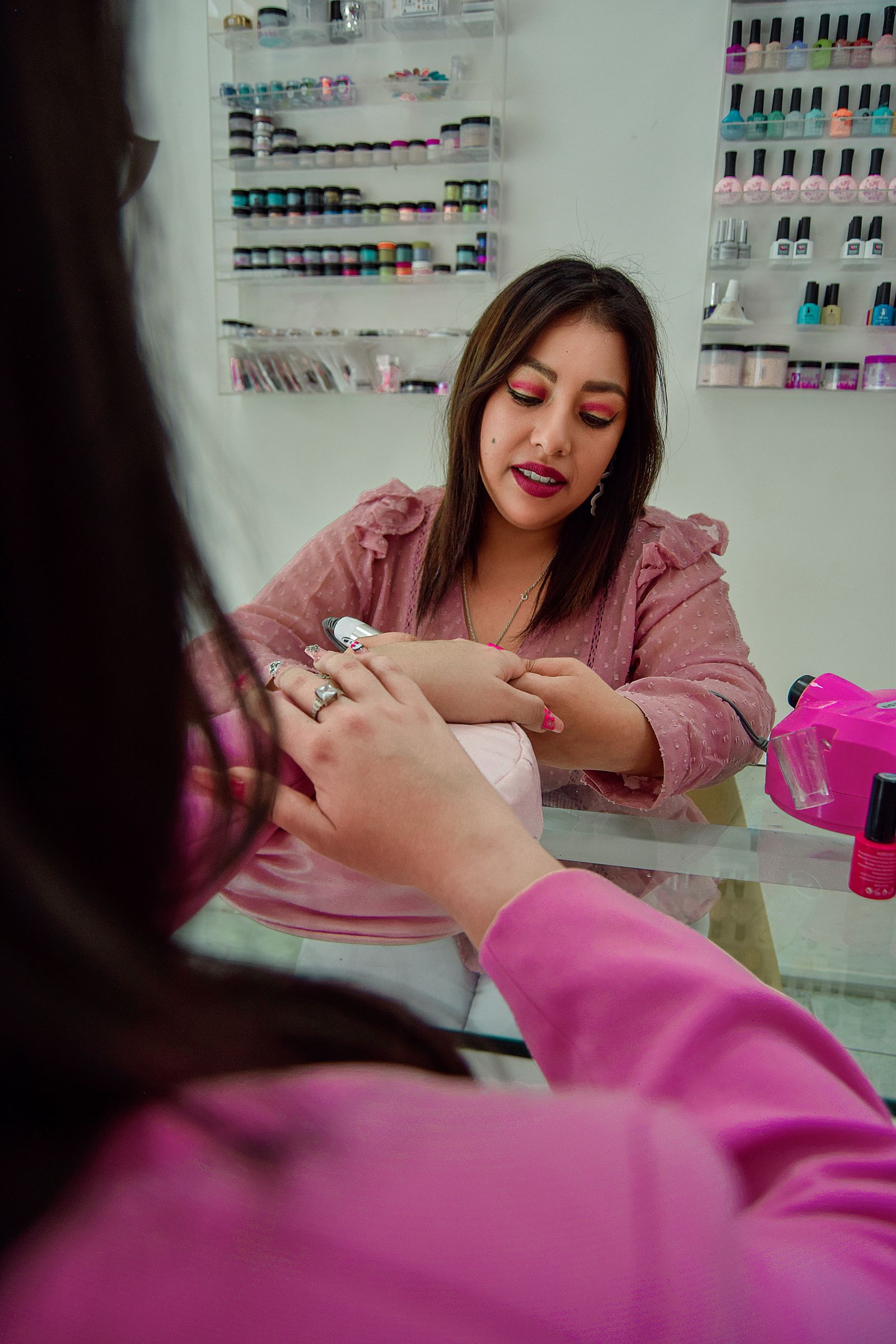
Typing, honestly assessed
Short to medium lengths with an almond or oval shape are the typist's friends, because the sides are filed away from the keys. Long square shapes catch the most: the corners hit first, the sound drives coworkers up the wall, and error rates climb until you switch to flatter finger angles. If you type for a living in Salisbury offices or from a home desk, say so plainly. A shape change often solves the problem people blame on length alone.
Healthcare, food work, and hands-on trades
Short is not a style failure in hands-on work; it is the tool fitting the job. Long nails trap more debris underneath, chip against equipment, and can puncture gloves. Many clinical settings ban enhancements outright because of infection control. If your role is anywhere near that line, the livable choice is a short, neat set (or a classic manicure with no extension at all) that you never have to apologize for or hide. Bring your constraints to E Nails & Spa and the recommendation will follow the job, not the trend photo.
The adjustment week, day by day
Days one and two are for learning where your fingertips now end. You will fumble a credit card out of a wallet slot and miss a light switch in the dark. Days three to five, the new map starts to stick: typing speeds return, and you stop leading with your knuckles. By day seven, most people with a sensible length forget about it except when they look at their hands. If day seven still feels like day one, the length is wrong for your life, and shortening at the next appointment is a fix, not a defeat. Shortening is quick; living annoyed for a month is not a virtue.

Growing into length gradually
The people happiest with long nails usually got there in stages: overlay at natural length, a small extension at the next visit, a little more after that. Each stage gets its own short adjustment period instead of one big one, and your technician learns how your nails hold up at each length. It is slower. It is also why their sets look effortless while a first-time jump to extra-long often ends in two broken nails and a full shortening by week two.
Common questions
What is the most practical length for a first set?
A short length that extends just past the fingertip. It reads as a finished set, types normally for most people, and leaves room to go longer next time.
Can I file long nails shorter myself at home?
You can take a small amount off natural nails, but shortening an enhancement changes its balance and shape. It is better handled at a fill appointment.
Does shape matter as much as length?
Often, yes. Almond and oval shapes catch less on keyboards and fabric than square corners at the same length, so shape can buy you comfort for free.
Photos in this guide are representative stock images.
← All guides from E Nails & Spa← Back to E Nails & Spa